More Episodes
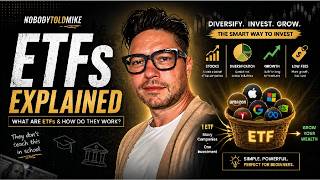
Money 101 · Episode 3
90% of professional fund managers — with MBAs, research teams and Bloomberg terminals — fail to beat the market over 10 years. The strategy that beats them costs almost nothing and takes 20 minutes to set up. Nobody told you this. Now you know.
Watch directly here or on YouTube
Not financial advice. This article is for educational and informational purposes only. I am not a financial advisor. Nothing here should be considered a recommendation to buy or sell any investment. Always do your own research and consult a qualified financial advisor before making any investment decisions.
Look... 90% of professional fund managers — people with MBAs, research teams, Bloomberg terminals and decades of experience — fail to beat a simple index fund over 10 years. Not occasionally. Consistently. Every single year. And yet most ordinary investors still pay for active management. This guide explains why that is a mistake and what to do instead.
An index fund is a fund that tracks a market index — a predefined list of assets — by simply buying everything on that list. The S&P 500 index fund buys all 500 companies in the S&P 500. The MSCI World index fund buys around 1,500 companies from 23 developed countries. No decisions. No stock picking. No fund manager trying to be clever. Just the market.
This approach is called passive investing — and it has consistently outperformed active investing over long time horizons for one simple reason: fees. Active funds charge 1–2% per year in management fees. Index funds charge 0.03–0.25%. Over 30 years, that difference in fees can cost you hundreds of thousands.
"The best index funds for beginners are the boring ones. Broad market, low fees, long time horizon. That is the entire strategy."
Look... this is not an opinion. It is one of the most studied findings in financial history. S&P Global publishes a report every year — the SPIVA Scorecard — that tracks how many active fund managers beat their benchmark index. The results are consistently damning for active management:
% of active fund managers who FAILED to beat their index
Source: S&P SPIVA Scorecard. The longer the time horizon, the worse active management looks relative to index funds.
The process is simpler than most people think. Here is the framework that works across every country:
Here are some of the most widely discussed index funds across different regions. This is not a recommendation — always do your own research:
Are index funds safe?
No investment is completely without risk. Index funds can and do fall in value during market downturns. However, a globally diversified index fund spreading across thousands of companies is significantly less risky than individual stock picking. Over long time horizons, global equity index funds have historically recovered from every crash.
What is dollar-cost averaging?
Dollar-cost averaging (DCA) means investing a fixed amount at regular intervals — for example €200 every month — regardless of whether markets are up or down. Over time this smooths out the impact of market volatility and removes the temptation to time the market.
Index fund vs ETF — which is better?
Both track an index and both are excellent for long-term passive investing. ETFs trade on exchanges throughout the day. Traditional index funds are priced once daily. For most long-term investors the difference is minimal — what matters far more is choosing low fees and staying consistent.