More Episodes
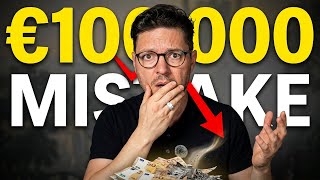
Money 101 · Episode 13I Calculated My Biggest Money Mistake. It Cost €100k.
Money 101 · Episode 14The Hedonic Treadmill: Why You Can't Buy Happiness
Money 101 · Episode 15My Neighbours Earn More Than Me. I Have More Than Them.
Money 101 · Episode 16
March 2020. I watched ninety thousand euros drop to sixty in one afternoon. I called my wife. Told her I needed to sell. Right now. She asked me one question back. That single question is the only reason I still have that money today.
Watch directly here or on YouTube
Not financial advice. For educational purposes only. I am not a financial advisor. Always do your own research and consult a qualified advisor before making any investment decisions.
Look... March 2020. I watched ninety thousand euros drop to sixty thousand in one afternoon. Not over weeks. One afternoon. I called my wife and told her we needed to sell. Right now. Before it got worse.
She asked me one question. I am not going to tell you what the question was here — watch the video. But that single question stopped me from doing the worst thing I have ever almost done with money. And in the months that followed, the portfolio recovered completely and went on to reach new highs.
"The loss did not cost me money. The panic almost did."
Look... this is not a weakness. It is biology. Your brain processes financial loss in the same region it processes physical pain. Research by Kahneman and Tversky consistently shows that losing money feels roughly twice as painful as gaining the same amount feels good. In March 2020, watching a portfolio fall 34% in 33 days activated the same part of the brain that responds to a physical threat. The instinct to act — to sell, to stop the bleeding — is not irrational. It is hardwired.
The problem is that the market does not care about your nervous system. Selling at the bottom does not stop the pain. It makes it permanent. A temporary loss becomes a realised loss the moment you sell.
Look... after the question my wife asked, I did not immediately feel calm. I still wanted to act. But I put the phone down and went for a walk. Thirty minutes. When I came back the urge had reduced enough that I did not act on it. That thirty-minute gap between the emotion and the decision may have been worth tens of thousands of euros in the long run. It is one of the most powerful tools in investing that nobody ever mentions — the deliberate pause between feeling and acting.
Investors who sold during the March 2020 crash and waited for the "right time" to re-enter the market largely missed the recovery. The S&P 500 recovered its losses within five months. Global equity markets reached new all-time highs within 18 months. The investors who held — or bought more — benefited from one of the fastest recoveries in market history. The investors who sold locked in losses at exactly the wrong moment.
What should I do when my portfolio crashes?
The research consistently supports holding through market downturns for long-term investors. Selling during a crash converts a temporary loss into a permanent one. Reviewing your investment thesis and time horizon before acting, and introducing a deliberate pause between emotion and decision, are widely recommended practices.
How do I stop panic selling?
The most effective strategies involve preparation before the crash, not during it. Writing down your investment plan and the reasons behind it in advance, setting rules about when you will and will not sell, and introducing a mandatory waiting period before acting on the urge to sell all significantly reduce panic selling behaviour.
Is it normal to want to sell during a market crash?
Yes, completely normal. The psychological response to a portfolio dropping sharply is a hardwired human reaction, not a character flaw. The research on loss aversion shows that losses feel roughly twice as painful as equivalent gains feel good. Understanding this helps explain the urge without acting on it.